Achieve Together: Robotics Class Journey

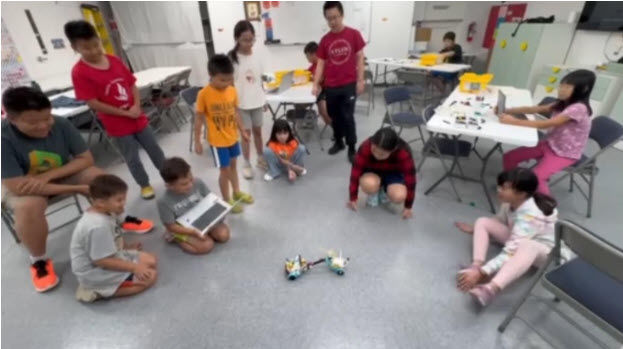
In the early summer of 2024, AYLUS Pearland members came together with a shared goal: to make a robotics class that would introduce young children to building and programming LEGO Spike Prime robots, the ones that are used in FLL (First Lego League).
The AYLUS Robotic program was founded by three Glenda Dawson High School students: Ethan Gao, Junxi Ding, and Chenyu Jin. Ethan coordinated logistics such as room reservations and overall organization of the summer camps. Junxi Ding served as the primary class information producer, while Chenyu Jin was responsible for documentation and written materials. As interest grew, the team expanded to eight members: Junxi Ding, Chenyu Jin, Ethan Gao, Shaotan Liu, Grace Ji, Ian Chiang, Michael Schmidl, and Roger Cui. All members are AYLUS Pearland member and are also part of the Paradox Robotics Team, where they have received systematic robotics training in FTC (First Tech Challenge).
Our initial meetings focused on developing LEGO robotics presentations and planning future lessons. Because our audience primarily consisted of younger children, we decided to base the curriculum on LEGO Spike Prime, which offers basic programming and engineering capabilities well-suited for beginners. These kits would remain the foundation of our lessons for the next few years.
Over the two-year period from 2024 to 2025, the Pearland Robotics Program conducted a total of 34 activities, providing training to approximately 340 students in grades 3–5.
Classes were held in a meeting room at a local library and Hua Xia Chinese school in Pearland. Between each session, we conducted debrief meetings to reflect on the previous class and continue refining our training slides and course materials.
Overview of the Six Lessons in 2024
Introduction to RoboticsThe first class introduced students to basic robotics concepts, with the primary goal of generating interest and engagement. Students were challenged to build a simple robot capable of driving.
Gears and Gear RatiosThe second lesson focused on gear trains, gear ratios, and torque. Students learned how to calculate gear ratios and observed real-world demonstrations, such as a mechanical fan. The hands-on challenge required students to use gears to increase their robot’s speed compared to the previous lesson.
SensorsStudents were introduced to the color, ultrasonic, and touch sensors included in the LEGO kits. Two sensor-based challenges were provided to reinforce understanding and prepare students for more advanced applications.
Maze ChallengeStudents were divided into two groups and tasked with building robots capable of navigating a maze using color sensors to follow colored paths. This lesson tested their sensor knowledge from the previous class.
Sorting AutomatonsStudents built robots that could move blocks differently depending on the color detected. This challenge emphasized sensor usage and required increased programming proficiency, with instructors providing guidance throughout.
Obstacle AvoidanceThe final lesson expanded on the previous challenge by requiring robots to both sort blocks and avoid obstacles. This proved to be the most difficult task, as it demanded strong logical thinking and advanced coding skills.
Program Expansion in 2025
In 2025, we revived the robotics program with more students and incorporated feedback from the previous year. Some students felt the 2024 curriculum was too easy, so we introduced more challenging lessons and activities.
Overview of the 2025 Lessons:
Sensors and Coding BasicsStudents learned about sensors, coding, and electronic components. The challenge involved programming the robot hub to produce sounds when sensors were triggered and enabling wheel movement.
Gears and BeltsThis lesson expanded on gear concepts, introducing belts and real-world applications. Students completed two challenges: building a fan using gears and constructing a robot capable of lifting 2–5 pound weights.
Simple Machines and Mechanical AdvantageStudents learned about simple machines, force, work, and mechanical advantage. They designed their own machines and competed to achieve the greatest mechanical advantage.
Maze NavigationSimilar to the previous year, students built and programmed robots to navigate a maze.
Newton’s Laws of MotionStudents learned the three laws of motion and applied the second law by building robots that could joust each other, testing the relationship between force, mass, and acceleration.
Catapult ChallengeStudents used physics concepts to design catapults capable of launching projectiles to knock down stacked blocks.
7-8. Robotic Arm Project
The final two lessons focused on building a robotic arm capable of grabbing, moving and sorting objects based on color. This capstone project required students to apply everything they had learned, emphasizing teamwork, troubleshooting, and iterative design.
The Hua Xia summer classes continued in 2025 with a similar structure to the previous year, though running more smoothly, student engagement increased, and participation was more evenly distributed. At the conclusion of both years, our team produced promotional and recap videos that documented the program (see below) and helped advertise future sessions.
In the future, The AYLUS Robotic program team will continue to identify robotics projects that appeal to children, motivation more students to actively engage in learning robotics. The program aims to enhance students’ hands-on skills and their ability to apply basic programming concepts. By introducing more children to robotics projects and fostering an interest in robotics activities, the team hopes to contribute to a richer and more diverse range of programs for children in the community.
Figure 1. Helping a group in the Maze Challenge project in 2024.

Figure 2. Beginning a demonstration of Gear ratios in the Gears and Gear Ratios presentation in 2024.

3. Final class in 2024 picture

4. Introduction to Robotic Functions for the Class of 2025

5. Creation of the robotic arm for the Robotic Arm Project in 2025

6. Creation of the robotic arm for the Robotic Arm Project in 2025

7. Preforming a demonstration about pullies in the Simple Machines Class in 2025

8. Robotics race to finish a maze in the Maze Challenge in 2025

9. Introduction to Robotics in 2025

10. The competition of Catapult Challenge in 2025